
MGC Joins 5-way Public-private Partnership in 1st Ship-to-ship Methanol Bunkering at Anchorage in Yokohama
February 9, 2026
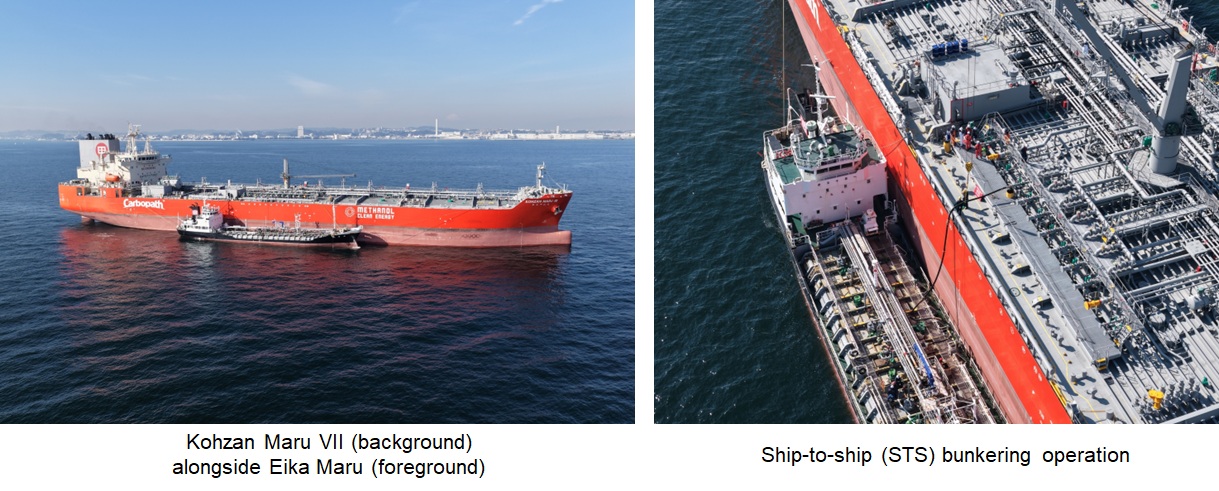
Mitsubishi Gas Chemical Company, Inc. (MGC; President: Yoshinori Isahaya; Head Office: Chiyoda-ku, Tokyo)today announced that the company teamed up with the City of Yokohama (Mayor: Takeharu Yamanaka), Kokuka Sangyo Co., Ltd. (Kokuka Sangyo; President and Representative Director: Kimifumi Imagawa; Headquarters: Minato-ku, Tokyo), Idemitsu Kosan Co. Ltd. (Representative Director and President: Noriaki Sakai; Headquarters: Chiyoda-ku, Tokyo) and Mitsui O.S.K. Lines, Ltd. (MOL; President & CEO: Takeshi Hashimoto) — collectively known as the “Five Parties” — to successfully complete Japan’s first (Note 1) ship-to-ship (Note 2) bunkering (Note 3) of methanol vessel fuel at anchorage (Note 4). Methanol fuel was transferred from the Eika Maru to the Kohzan Maru VII in the Yokohama District of Keihin Port.
The Eika Maru is a coastal methanol transport vessel operated by Kokuka Sangyo and the Kohzan Maru VII is a dual-fuel, ocean-going, methanol-transport vessel operated by MOL, and both are chartered by MGC. This operation also used domestically produced biomethanol (Note 5) from MGC’s Niigata Plant, which is scheduled to be used as fuel for the future operation of the Kohzan Maru VII.
(Note 1) According to a survey of participating companies.
(Note 2) The act of supplying fuel from one vessel to another while the vessels are alongside each other.
(Note 3) The act of supplying fuel for use on board a ship.
(Note 4) An area designated for vessels to drop anchor offshore or within a port, allowing them to anchor or wait safely.
(Note 5) Biomass characteristics assigned through the mass balance method.
[Operation Summary]
Date: Friday, February 6, 2026
Location: Keihin Port Yokohama District NR Anchorage
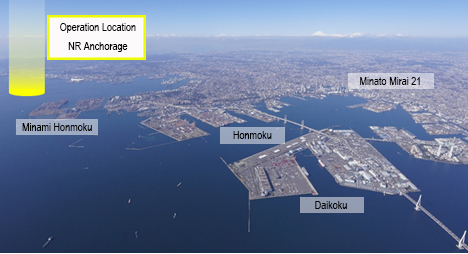
Yokohama Port Aerial Photo
Operation Vessel Specifications:
Receiving vessel Bunkering vessel
Ship name Kohzan Maru VII Eika Maru
Gross tonnage 29,969 498
Deadweight tonnage 47,960 1,259
Operator MOL Kokuka Sangyo
Methanol, a basic chemical, is used in a wide range of applications. It is also recognized as a clean-burning fuel, emitting low levels of CO2, sulfur oxides (SOx), nitrogen oxides (NOx), and particulate matter (PM). In the shipping industry, adopting alternative fuels to replace heavy fuel oil is one strategy for reducing GHG emissions. Methanol is gaining attention as a promising alternative fuel due to its ease of handling within existing infrastructure, leading to an increase in orders for methanol-fueled vessels. Methanol produced from non-fossil sources—such as CO2, waste plastics, and biobased feedstocks—enables carbon-neutral marine transport across its entire lifecycle.
The Ports and Harbors Bureau of Japan’s Ministry of Land, Infrastructure, Transport and Tourism (MLIT) established standards for implementation procedures and safety measures regarding bunkering of methanol-fueled vessels through the “Study Group on the Formation of Methanol Bunkering Hubs” from 2024 to 2025. The bunkering operation at this anchorage was made possible based on findings from a methanol bunkering simulation conducted in Yokohama Port in September 2024 and other insights related to the domestic transport of chemicals, including methanol. Those insights were brought by multiple stakeholders, including the operators (the Five Parties). Stakeholders and MLIT, along with the Japan Coast Guard discussed procedures and safety measures for implementation, which contributed to the successful execution of this operation.
Anchorage bunkering is a highly convenient operational method already used for conventional marine fuels, and a similar rise in demand is expected for methanol bunkering. This project marks Japan’s first ship-to-ship methanol bunkering operation at anchorage for methanol-fueled vessels in service, representing a significant milestone in promoting methanol bunkering within Japan. Moving forward, stakeholders will systematically organize and visualize insights gained through post-operation verification of this project. The Five Parties expect that these findings will be applied to methanol bunkering operations involving other vessel types or in other regions of Japan. Building on this project as a starting point, MGC will continue advancing initiatives to further develop and promote methanol bunkering throughout Japan.
MGC is currently promoting CarbopathTM, MGC’s environmentally sustainable platform for carbon cycling that uses captured CO2 emissions, waste plastics, biomass, etc. to manufacture methanol, which is then converted into fuels, materials and chemicals. The Bio-methanol supplied as part of the fuels for this bunkering initiative was produced at MGC's Niigata Plant using Biogas as its feedstock, in accordance with the mass balance method. Furthermore, since 2024, MGC and Idemitsu Kosan have been collaborating to build a domestic methanol supply system targeting the marine fuel market, and this initiative is part of that partnership.
Under our group mission "Creating value to share with society," MGC is committed to supplying methanol for marine fuels as well as preparing the environmental infrastructure. MGC further accelerates its contribution to a carbon-neutral society by expanding its methanol based value chain spanning manufacturing, supply, transportation and utilization.
[Company Profiles]
(1) City of Yokohama
The City of Yokohama, home to Yokohama Port—one of Japan’s leading ports—is developing a “Carbon Neutral Port” that aims to achieve net-zero greenhouse gas emissions. This initiative will be advanced by enhancing port functions with decarbonization in mind, including promoting the shift to next-generation energy sources for vessels and coastal industries, as well as creating clusters of coastal industries. To achieve carbon neutrality at the port by 2050, the city is pursuing these efforts in collaboration with the national government, private companies, and other stakeholders.
(2) Kokuka Sangyo Co., Ltd.
Kokuka Sangyo was established in March 1947 and fully entered the shipping industry in 1956, beginning with the transportation of coal and rayon products . Since the 1960s, Kokuka Sangyo has been engaged in the domestic and international transportation of methanol via dedicated carriers , as well as in operating specialized tankers and general chemical tanker vessels. Today, these operations remain Kokuka Sangyo's core business. Both domestic transportation and international trade deeply depend on sea routes. Through safe operation and strict quality control, Kokuka Sangyo continues to play an important role as vital infrastructure supporting both economic activity and daily life through maritime transport.
(3) Idemitsu Kosan Co.,Ltd.
In the fields of Petroleum, Basic Chemicals, High-Performance Materials, Power/Renewable Energy, and Resources, the company engages in the development, manufacturing, and sales of a wide variety energy and materials based on relationships of trust with partners and customers in a variety of fields. To contribute to achieving a carbon neutrality and a circular society by 2050, we continue to pursue new challenges by leveraging our domestic and international networks to advance the societal implementation of diverse and environmentally friendly “Energy One-step Ahead” solutions such as synthetic methanol (e-methanol).
(4) Mitsui O.S.K. Lines, Ltd.
MOL has established the “MOL Group Environmental Vision 2.2” and aims to achieve net-zero GHG emissions across the entire group by 2050 through five key actions. As part of this effort, MOL is pursuing the adoption of clean energy and plans to deploy 90 LNG/methanol-fueled ocean-going vessels. Leveraging the expertise gained from operating one of the world’s largest methanol carrier fleets, MOL will contribute to further reducing GHG emissions and achieving net-zero emissions.
END
Inquiries
Public Relations Department
Administrative & Personnel Division
MITSUBISHI GAS CHEMICAL COMPANY, INC.
TEL: +81-3-3283-5040
 PDF:449.88KB)